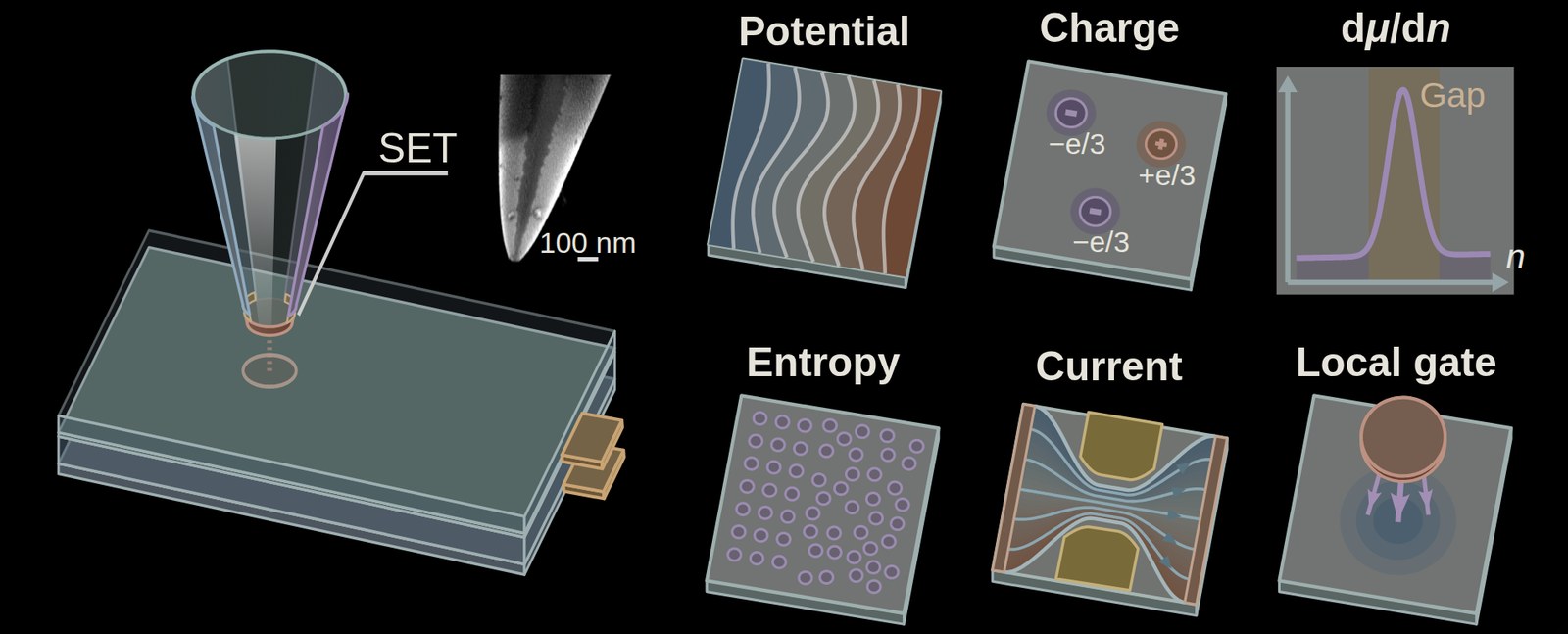
A scanning SET turns the world’s most charge-sensitive quantum device into a local probe of quantum materials. It reaches a charge resolution of 10⁻⁵ e, a potential resolution of 10 μeV and a spatial resolution of about 100 nm, which lets it map electrostatic potential, local charge, thermodynamic quantities such as the chemical potential, compressibility (dμ/dn) and entropy, and current flow. Because it couples to the sample capacitively, it is minimally invasive, works on encapsulated samples, and can double as a local gate.
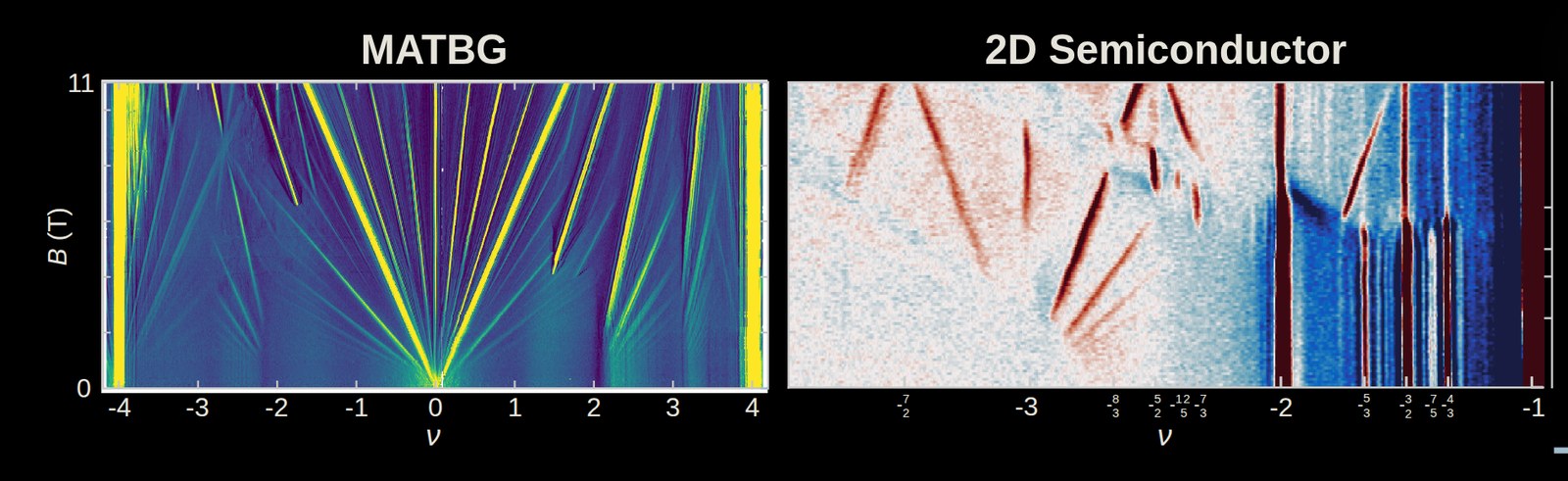
As the first member of the lab at Stanford, I built a scanning SET system with leading performance and used it to study a range of strongly correlated two-dimensional moiré systems. We pioneered its use for measuring correlated Hofstadter spectra and identifying signatures of unconventional charge excitations, and were the first to bring the technique to two-dimensional semiconductors.